Many construction firms in Ballarat assume the subsurface is uniform basalt or alluvium until they hit unexpected rock layers or groundwater zones mid-excavation. That assumption costs time and money. Electrical resistivity and VES surveys map resistivity contrasts in the ground, revealing buried channels, weathered zones, and water tables before a single drill hole is placed. In Ballarat’s complex geological setting — where mafic volcanic flows interbed with alluvial sediments — this non-invasive method provides a continuous profile that point tests alone cannot deliver. Complementing resistivity with a calicatas exploratorias campaign helps correlate geophysical anomalies with actual soil conditions.
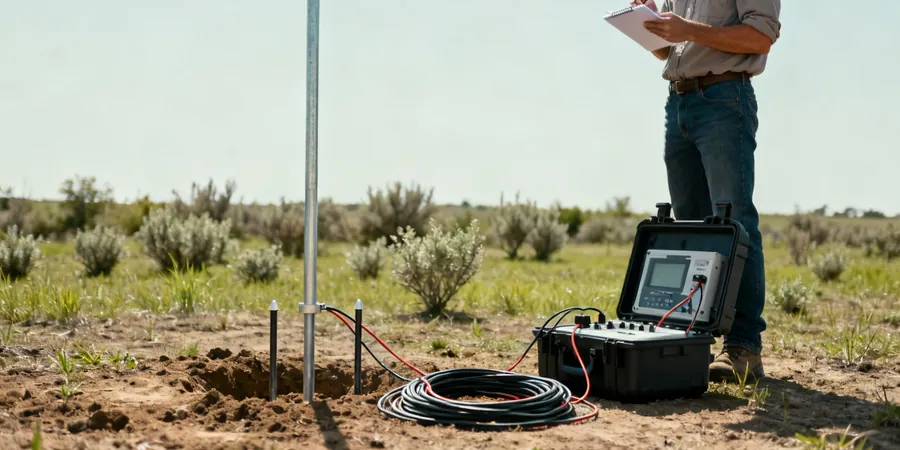
A single VES profile across a Ballarat site can detect hidden paleochannels, weathered dykes, and perched water tables that boreholes may miss entirely.
Technical details of the service in Ballarat
Typical technical challenges in Ballarat
In Ballarat, many sites sit on basalt flows that mask deeper alluvial aquifers. A resistivity survey can detect these, but only if the electrode array is long enough to reach target depth. We often see developers commissioning short profiles that stop at 10 m, missing a perched water table at 15 m that later causes excavation instability. Another risk is interpreting resistivity values without local ground truth. High resistivity may indicate basalt or dry sand; low resistivity may indicate clay or saline water. Without calibration with borehole data, the inversion can mislead. Always pair resistivity with at least one direct method, such as test pitting or SPT, to validate the geophysical model.
Our services
Our Ballarat office provides two core electrical resistivity services tailored to local ground conditions.
2D Electrical Resistivity Tomography (ERT)
Multi-electrode ERT surveys for foundation design, groundwater detection, and void mapping. Ideal for residential subdivisions, commercial buildings, and mining exploration in the Ballarat region.
Vertical Electrical Sounding (VES)
1D resistivity sounding using Schlumberger or Wenner arrays. Suitable for depth-to-bedrock estimation, aquifer delineation, and preliminary site classification. Quick deployment for small to medium-sized projects.
Q&A
What is the difference between 2D ERT and VES?
2D ERT produces a continuous cross-section of resistivity variations both laterally and with depth, ideal for mapping complex geology like buried channels or dykes. VES provides a 1D vertical profile at a single point, best for simple layered ground where lateral changes are minimal. In Ballarat's variable volcanic-alluvial setting, 2D ERT is generally preferred for detailed site characterisation.
How deep can a VES survey reach in Ballarat?
A standard VES array with maximum electrode spacing of 100 m can achieve investigation depths of 30–40 m in typical Ballarat soils. Deeper targets (up to 100 m) require extended layouts and higher transmitter power, which we can accommodate for mining or groundwater studies. The actual depth depends on electrode spacing, current injection capability, and subsurface resistivity contrasts.
What is the typical cost range for an electrical resistivity survey in Ballarat?
For a standard 2D ERT survey covering 200 m of profile, the cost typically ranges between AU$940 and AU$1,590, including field work, data processing, and a report. VES surveys at a single point start from AU$650. Prices vary with site access, line length, and required depth. Contact us for a detailed quote based on your specific project dimensions.
Coverage in Ballarat
Visual overview
This service complements our laboratory testing work for a complete project analysis.