A two-storey commercial development on Sturt Street recently showed floor cracking just weeks after slab pour. The culprit was not poor concrete — it was differential settlement over variable clay layers. In Ballarat, this pattern repeats when fill thickness changes abruptly across a site. That is why settlement analysis must happen before foundations go in, not after cracks appear. We combine field data from boreholes with laboratory consolidation tests to predict how much a soil layer will compress under load. The result is a settlement contour map that tells engineers exactly where to adjust footing depth or slab reinforcement. Before pouring any slab, we recommend pairing this study with a placa de carga test to verify the modulus of subgrade reaction at working stress levels.
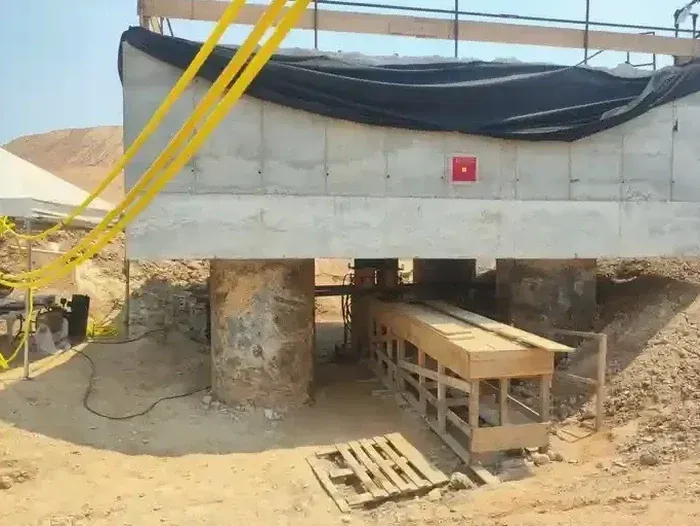
Differential settlement in Ballarat's variable clay profiles can exceed 25 mm across a single building footprint if fill thickness is not mapped beforehand.
Technical details of the service in Ballarat
Typical technical challenges in Ballarat
In Ballarat, the most overlooked risk is settlement on fill that was placed decades ago without compaction control. Historic mining and quarry areas around the city have undocumented fill depths reaching 4 metres in places. If settlement analysis is skipped on those sites, a new slab can settle 40 to 60 mm while adjacent strip footings on natural ground barely move. That differential pulls walls apart and jams doors. We always request a full site history and check old mining records before planning the borehole layout, because standard grid spacing can miss a buried pit.
Our services
We offer a complete set of settlement analysis services tailored to Ballarat's ground conditions, from initial field investigation to final numerical modelling.
Consolidation Testing (Oedometer)
Laboratory testing on undisturbed tube samples to determine Cc, Cr and Cv values. Results include time-settlement curves for each load increment.
Settlement Modelling & Contour Mapping
Finite layer analysis using software calibrated with local soil data. Output includes total and differential settlement contours at 5 mm intervals.
Fill Assessment & Pre-Construction Monitoring
Boreholes through existing fill to measure density and moisture content. Settlement plates and survey monitoring during preload or surcharge stages.
Q&A
What is the difference between total settlement and differential settlement?
Total settlement is the absolute downward movement of a foundation relative to its original level. Differential settlement is the difference in movement between two points on the same structure. In Ballarat's variable clay profiles, differential settlement often causes more damage than total settlement because it induces angular distortion in walls and frames.
How many boreholes are needed for a reliable settlement analysis on a residential block?
For a standard residential lot up to 800 m², we recommend a minimum of three boreholes to capture variability in fill thickness and clay stiffness. If the site has a history of mining or old creek channels, we increase the density to five boreholes. Each borehole includes undisturbed sampling at 1.5 m intervals for oedometer testing.
What is the typical cost range for a settlement analysis in Ballarat?
For a single residential dwelling, the cost range is AU$1,030 to AU$2,600 depending on the number of boreholes and laboratory tests required. Larger commercial sites with multiple boreholes and numerical modelling fall at the upper end of this range. We provide a fixed quote after reviewing the site history and proposed structure.
Can settlement analysis predict movement from seasonal moisture changes?
Yes, but only if the laboratory testing includes swelling pressure and shrinkage index measurements. In Ballarat's reactive clay zones, we extend the analysis to cover cyclic moisture changes by modelling the soil suction profile under worst-case wet and dry seasons. This is critical for slab-on-ground designs where edge moisture variation can cause up to 30 mm of differential heave.