Ballarat's subsurface reflects its gold rush legacy: deep alluvial sands over weathered bedrock, often interbedded with historic sluicing tailings and loose fill. SPT N-values in the top 6 m commonly range from 2 to 12 in uncompacted zones, with groundwater as shallow as 3 m near the Yarrowee River. For sites requiring improved bearing capacity and reduced liquefaction potential, vibrocompaction design offers a reliable method to densify cohesionless soils. We tailor each probe spacing and energy input to the local gradation curve, referencing AS 4678 for earth-retaining structures and AS 1726 for subsurface logging. In Ballarat, where settlement tolerances for commercial pavements are tight, this technique achieves relative densities above 75 % without importing granular material.
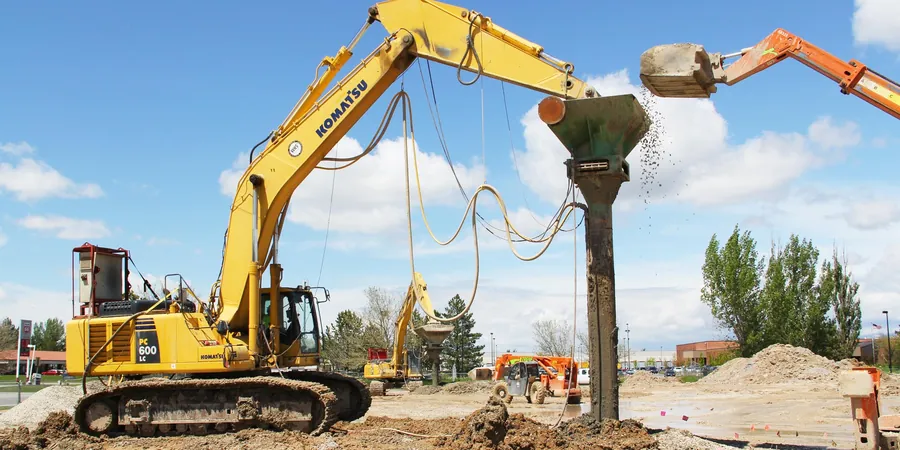
Vibrocompaction in Ballarat reduces void ratio of mine fill from 0.85 to below 0.55, achieving SPT N-values > 25.
Technical details of the service in Ballarat
Typical technical challenges in Ballarat
Vibratory probes used in Ballarat generate peak accelerations around 10 g at the tip, which can destabilise adjacent structures if not controlled. We specify an exclusion zone of at least 6 m from existing footings and monitor vibrations with seismographs on heritage buildings like those in the Lydiard Street precinct. Another risk is encountering buried timber or metal debris from historical mining operations; we pre-clear the probe path with a magnetometer survey. In saturated zones, vibrocompaction may temporarily increase pore water pressure, requiring a rest period of 12–24 hours between passes. Our team logs each probe withdrawal speed and energy consumption to confirm consistent densification across the grid.
Our services
We offer three service tiers for vibrocompaction design in Ballarat, each aligned with project scale and ground conditions.
Full vibrocompaction design with verification testing
Includes borehole layout, probe spacing optimisation, energy input calculations, and post-treatment SPT or CPT verification. Suitable for commercial and industrial slabs on ground.
Vibrocompaction for seismic liquefaction mitigation
Targets loose sand layers identified by liquefaction hazard analysis. Design follows NCEER 2001 procedures and includes pore pressure dissipation checks. Ideal for schools and critical infrastructure in Ballarat.
Vibrocompaction for variable fill thickness
Adapts probe depth and backfill type to irregular fill profiles common in former mining areas. Includes trial compaction cell and acceptance criteria based on relative density.
Q&A
What is the typical cost range for vibrocompaction design in Ballarat?
For a standard commercial project, the design and verification scope ranges from AU$2,080 to AU$8,790 depending on grid size, target depth, and post-treatment testing requirements.
How does vibrocompaction differ from dynamic compaction?
Vibrocompaction uses a deep vibratory probe to densify loose sands and gravels at depth without impacting the surface significantly. Dynamic compaction relies on repeated high-energy drops from a crane to densify from the top down. Vibrocompaction is preferred in Ballarat where adjacent structures limit the use of heavy drops.
Can vibrocompaction treat soils with more than 15% fines?
Yes, but effectiveness decreases as fines content rises. For silty sands with 15–25% fines, we often pre-treat with wick drains to reduce pore pressure during compaction. Above 25% fines, alternative methods like stone columns or deep soil mixing are more appropriate.
What post-treatment testing is recommended after vibrocompaction?
We typically specify SPT or CPT at a frequency of one test per 25 grid points, plus plate load tests on critical areas. Field density tests using a sand cone or nuclear gauge confirm relative density targets. In Ballarat, we also monitor settlement under a trial load for sensitive slab designs.