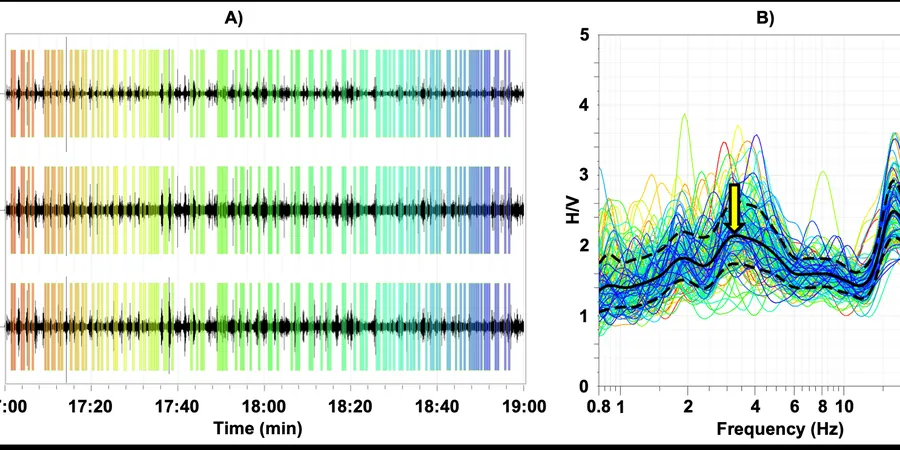
Ballarat sits at an elevation of 435 meters above sea level, with much of its urban development underlain by Quaternary alluvial and volcanic deposits from the surrounding extinct shield volcanoes. For any medium-to-high-rise project proposed within the Ballarat central business district or along the Midland Highway corridor, the single most critical parameter is the natural site period — and that is exactly what an HVSR microtremor survey (Nakamura method) captures. This passive seismic technique records ambient vibrations to identify the fundamental resonance frequency of the soil column, information that directly shapes how the structure interacts with the ground during seismic loading. Without this measurement, engineers risk designing a building whose fundamental frequency coincides with the site frequency, a condition that can amplify ground motion by a factor of three or more. Combining the HVSR data with a detailed classification of soils and a targeted response spectrum analysis provides a complete picture of the seismic demand at the site.
A difference of just 0.5 Hz in the site's natural frequency can shift a building from safe to critically resonant during a seismic event.
Technical details of the service in Ballarat
- Fundamental resonant frequency (f0) in Hz.
- Peak H/V amplitude — an indicator of impedance contrast.
- Site class per AS 1170.4 and NEHRP provisions.
This survey is especially useful prior to deep excavations because knowing the soil-column period helps anticipate how the excavation will respond to vibration, and we routinely pair it with monitoring of excavations to verify assumptions during construction.
Typical technical challenges in Ballarat
Consider a four-storey commercial building planned on Creswick Road where the soil profile consists of 12 metres of soft clay over weathered basalt. Without an HVSR microtremor survey (Nakamura method), the structural engineer might assume a stiff soil condition and design for a short-period response. The survey would reveal a fundamental frequency near 1.8 Hz, placing the building's first-mode period dangerously close to resonance. The consequence is amplified accelerations at the roof level, leading to non-structural damage, potential pounding with adjacent structures, and a factor of safety that drops below acceptable limits for the design earthquake. This scenario is precisely why the Nakamura method is now considered essential due diligence for any project in Ballarat where the subsurface is variable.
Our services
We offer two complementary HVSR survey formats tailored to different site conditions and project budgets in Ballarat.
Single-Station HVSR Survey
A rapid, cost-effective measurement using one Tromino sensor deployed for 30 minutes. Ideal for preliminary site classification and identifying the fundamental frequency at a specific borehole location. Suitable for low-rise residential and small commercial projects.
Multi-Station HVSR Array Survey
Three or more stations deployed in a triangular or linear array to produce a 2D pseudo-section of the site period across the entire footprint. This is the preferred option for medium-to-high-rise buildings and infrastructure projects where lateral variability is expected.
Q&A
What is the Nakamura method and how does it work for an HVSR microtremor survey?
The Nakamura method, also known as the horizontal-to-vertical spectral ratio (H/V) technique, analyzes ambient seismic noise recorded by a three-component seismometer. The ratio of the horizontal spectrum to the vertical spectrum isolates the site response, revealing the fundamental resonance frequency of the soil column without needing an active source.
How many HVSR stations do I need for a typical building site in Ballarat?
For a single building footprint up to 1,500 m², one station placed at the center of the site is usually sufficient. For larger footprints, irregular geometries, or sites where the geology changes abruptly — such as near the old alluvial channels under Ballarat — we recommend a three-station array to capture lateral variation.
How much does an HVSR microtremor survey cost in Ballarat?
The typical cost for a single-station HVSR survey in Ballarat ranges from AU$2,310 to AU$3,700, depending on site access, number of stations, and reporting requirements. Multi-station arrays are quoted individually based on the scope.
Does the HVSR method replace the need for a borehole and SPT testing?
No. The HVSR microtremor survey provides the site period and identifies potential resonance issues, but it does not measure shear-wave velocity directly. For a complete site characterization, we combine the HVSR data with a borehole and SPT log (per AS 1726) to obtain the Vs30 value and confirm the stratigraphy.
What is the difference between f0 from HVSR and the site period used in AS 1170.4?
The fundamental frequency f0 measured by the HVSR method is the actual resonance of the soil column at the site. AS 1170.4 defines site classes (A to E) based on the average shear-wave velocity in the top 30 metres (Vs30). The f0 value is not directly used in the code, but it is a powerful cross-check: if the calculated fundamental period of the building falls within 0.8 to 1.2 times the site period, resonance is likely and a more detailed dynamic analysis is warranted.