Ballarat sits atop deep Tertiary basalt flows and alluvial sediments from the Yarrowee River catchment. The volcanic profile often produces stiff clays with high plasticity, while the alluvial corridors bring variable sand and gravel layers. Groundwater can sit within 3 meters in low-lying suburbs like Wendouree and Lake Gardens. A soil mechanics study in Ballarat must account for these sharp lateral changes to avoid differential settlement. The work starts with test pits and boreholes to log the profile, then lab tests measure strength, moisture content, and collapse potential. Before interpreting results, the team runs a plate load test to verify bearing capacity in the stiff clay crust. This sequence ensures the design values match what the ground actually delivers.
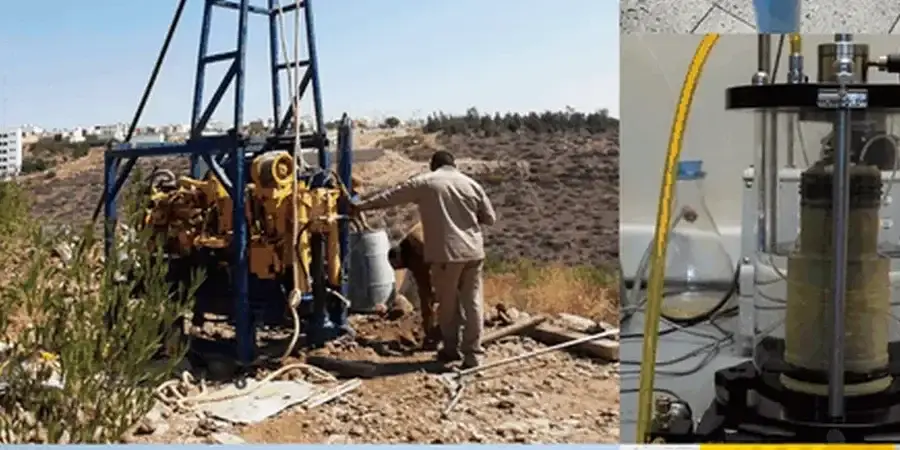
The volcanic clays of Ballarat can swell up to 8% under wet conditions — a soil mechanics study quantifies that risk before the slab is poured.
Technical details of the service in Ballarat
Typical technical challenges in Ballarat
A common mistake on Ballarat sites is assuming the stiff surface clay extends uniformly down. It does not. Below the desiccated crust, the clay softens and can become highly compressible. Builders who skip the soil mechanics study often face cracked slabs within two years. The real risk is differential settlement between the basalt clay zones and the alluvial pockets. Without proper boreholes and lab testing, the foundation may be undersized for the actual bearing layer. The cost of remediation — underpinning, slab jacking, or even demolition — far exceeds the study fee. A thorough investigation identifies these weak layers early and allows the engineer to design footings that suit the real ground conditions beneath Ballarat.
Our services
Our soil mechanics study in Ballarat covers the full investigation cycle — from field drilling to lab analysis and foundation recommendations.
Borehole Drilling & Sampling
Continuous flight auger drilling to depths of 10-15 m, with undisturbed tube sampling for lab strength tests.
In-Situ
Standard penetration tests, pocket penetrometer, and vane shear in the clay layers to get immediate strength data.
Laboratory Classification
Grain size distribution, Atterberg limits, moisture content, and density — all per AS 1726 and ASTM standards.
Foundation Analysis & Report
Bearing capacity calculation, settlement estimate, shrink-swell assessment, and a clear footing recommendation.
Q&A
How deep should boreholes be for a soil mechanics study in Ballarat?
For standard residential construction, we drill to at least 5 m or until we reach competent bearing material. For multi-storey or commercial projects, depths of 10-15 m are typical to capture the full clay profile and any alluvial lenses.
What is the typical cost of a soil mechanics study in Ballarat?
A standard soil mechanics study for a house block in Ballarat ranges from AU$4.550 to AU$7.240. The final figure depends on the number of boreholes, depth, and required lab tests. Contact us for a quote tailored to your site.
How long does the soil testing process take from drilling to final report?
Field drilling usually takes one day for a typical residential site. Lab testing adds 5-7 working days. The complete report, including foundation recommendations, is ready within 10 working days from the start of drilling.
Coverage in Ballarat
Visual overview
This service complements our laboratory testing work for a complete project analysis.