The soil profiles across Ballarat vary notably between the volcanic basalt flows around Mount Buninyong and the alluvial flats near Lake Wendouree. In the basalt zones, we often encounter stiff clays and weathered rock that demand a higher blow count to penetrate, whereas the sedimentary deposits along the Yarrowee River corridor show looser sands and soft clays. Running a Standard Penetration Test in Ballarat gives us the N-value needed to differentiate these units quickly. We correlate that N-value directly with relative density or consistency using the relationships in AS 1726. It is a fast, reliable way to log strength on site without waiting for lab results. For shallow foundations, we often pair SPT data with a plate load test to confirm bearing capacity under real load conditions.
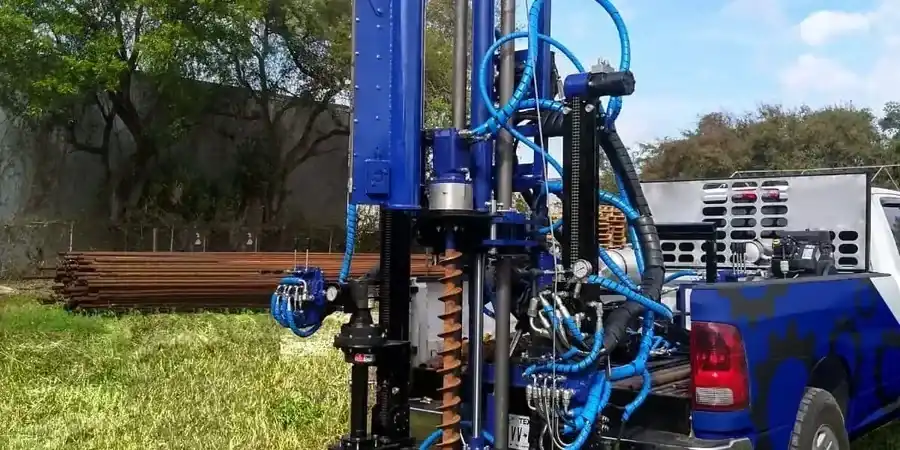
N-values from SPT in Ballarat's basalt clays often exceed 30 blows per 300 mm, indicating very stiff to hard consistency at depths below 3 metres.
Technical details of the service in Ballarat
Typical technical challenges in Ballarat
We often see projects where the designer assumes uniform bearing capacity across the site based on one or two SPT holes. In Ballarat, that assumption is risky because the basalt flows are irregular — one bore might hit hard rock at 4 metres while another 20 metres away finds soft clay to 8 metres. The Standard Penetration Test in Ballarat needs to be spaced to capture that variability, especially where volcanic dykes or old stream channels cut through the profile. We recommend a grid pattern with at least one SPT per 200 sqm for commercial slabs. The cost of an extra test is small compared to differential settlement repair.
Our services
Our SPT service in Ballarat covers the full scope from drilling through to certified reporting. We tailor each program to the site geology and project class.
Residential SPT for house slabs
Single-bore SPT to 6 m depth with N-value logging every 1.5 m. Suitable for Class M to H site classification under AS 2870. Includes water table observation and soil description.
Commercial SPT for warehouses and offices
Multiple bore SPT program to 15 m depth with continuous sampling. Blow counts correlated to bearing capacity and settlement estimates. Report includes bore logs and N-value profiles.
SPT for retaining wall design
SPT data used to derive friction angle and lateral earth pressure coefficients for wall design to AS 4678. Bores located along the wall alignment to capture soil variability.
SPT for pavement and road subgrade
Shallow SPT bores to 3 m depth for CBR correlation and subgrade modulus estimation. N-values converted to California Bearing Ratio using local correlation curves.
Q&A
What is the difference between N-value and SPT blow count?
The N-value is the total number of blows required to drive the split-spoon sampler the final 300 mm after an initial 150 mm seating drive. The blow count per 150 mm increment is recorded separately, but the N-value is the standard parameter used for correlations. It directly represents the penetration resistance of the soil.
How deep can the Standard Penetration Test reach in Ballarat soils?
In the alluvial sands and clays along the Yarrowee River corridor, we can reach 15 to 20 metres without issue. In the basalt zones, refusal often occurs between 4 and 8 metres when the weathered rock becomes too hard. The hammer energy limits penetration in dense materials.
What is the typical cost range for an SPT in Ballarat?
For a single SPT bore to 6 metres depth, including mobilisation, drilling, logging, and a basic report, the cost typically ranges between AU$750 and AU$1,310. Multi-bore programs reduce the per-test cost due to shared mobilisation. The exact price depends on access conditions and required depth.
Can SPT data be used for liquefaction assessment in Ballarat?
Yes, SPT N-values are the primary input for the simplified liquefaction triggering method (Seed & Idriss, 1971; Youd & Idriss, 2001). In Ballarat, the alluvial deposits near Lake Wendouree and the Yarrowee River are the zones of concern. We apply the magnitude scaling factors and fines content corrections per NCEER guidelines.
How do you handle refusal in basalt when doing an SPT?
When the blow count reaches 50 blows for any 150 mm increment, we stop the SPT and record it as refusal. We then switch to rotary coring to recover intact rock core for strength testing. The refusal depth is logged and the core is classified per AS 1726 before moving to the next bore location.
Coverage in Ballarat
Visual overview
This service complements our laboratory testing work for a complete project analysis.