The contrast between Ballarat's volcanic basalt flows around Lake Wendouree and the deeper alluvial sequences beneath the city centre creates a sharp dichotomy in seismic site response. In the eastern suburbs, stiff soils over basalt produce minimal amplification, whereas the soft clay and silt deposits near the Yarrowee River can amplify long-period motions by a factor of 1.5 to 2.0 relative to the standard reference. Understanding these site-specific effects requires a detailed response analysis that accounts for the full soil profile, not just the upper five metres. We combine MASW surveys with HVSR microtremor measurements to capture the shear-wave velocity structure down to 30 metres, which feeds directly into the amplification seismic analysis that defines the design spectrum for each project.
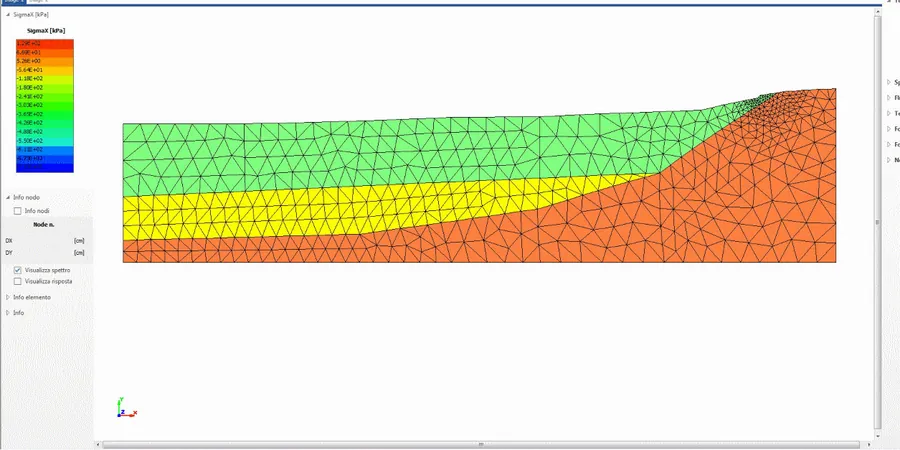
We combine MASW surveys with HVSR microtremor measurements to capture the shear-wave velocity structure down to 30 metres.
Technical details of the service in Ballarat
- Measuring Vs30 via MASW or ReMi array to classify the site per AS 1170.4 Site Class C, D, or E;
- Running 1D SHAKE or DeepSoil analysis with input motions scaled to Ballarat's hazard level (0.08 g PGA for 500-year return period);
- Computing the acceleration response spectrum at the surface for each soil column.
Typical technical challenges in Ballarat
The shallow water table in Ballarat's low-lying areas — often less than 3 metres below ground — elevates the risk of liquefaction-induced ground failure during a seismic event. Soft saturated silts and loose sands within the alluvial sequence can lose strength abruptly when cyclic shear stresses exceed a threshold. Our site response analysis in Ballarat explicitly includes pore-pressure generation models (Seed-Idriss simplified method and more advanced PM4Sand) to flag whether excess pore pressures approach effective stress loss. For sites near the Yarrowee Creek corridor, we also evaluate the potential for lateral spreading and differential settlement, both of which can sever utilities and tilt foundations beyond repair.
This service complements our laboratory testing work for a complete project analysis.
Our services
We offer a complete suite of field and laboratory services to support site response analysis in Ballarat, from initial site classification through to final design spectra.
MASW and ReMi Surveys
Non-invasive shear-wave velocity profiling using multichannel analysis of surface waves or refraction microtremor. We deploy 24-channel seismographs with 4.5 Hz geophones along 70-metre arrays to resolve Vs profiles down to 30 metres, classifying the site for AS 1170.4 compliance.
HVSR Microtremor Measurements
Single-station horizontal-to-vertical spectral ratio recordings at 10+ points across the site to identify the fundamental resonance frequency and confirm 2D basin-edge effects. This is especially valuable in Ballarat where buried paleochannels create sharp impedance contrasts.
Non-linear Dynamic Analysis
1D and 2D non-linear time-history analysis using DeepSoil with PM4Sand and PM4Silt constitutive models. We provide acceleration and displacement response spectra, plus amplification factors for each soil column, fully documented with input motions and parameter sensitivity runs.
Q&A
How does Ballarat's geology affect site response analysis?
Ballarat sits on a mix of basalt flows, alluvial silts, and gold-mining fill. The stiff basalt layers produce minimal amplification, while the soft alluvial deposits near the Yarrowee River can amplify ground motions by 1.5 to 2 times. Site response analysis must model the full soil column, including the transition from soft to stiff layers, to capture the true amplification pattern.
What is the typical cost of a site response analysis in Ballarat?
For a standard single-borehole analysis with MASW and HVSR, the cost ranges between AU$1,780 and AU$6,890 depending on the number of measurement points, the complexity of the soil profile, and whether non-linear constitutive models are required. A full multi-point study with 3D effects falls at the higher end.
Which Australian standard governs site response analysis?
AS 1170.4-2007 establishes the earthquake actions framework, including site classification based on Vs30. The analysis methodology follows the NEHRP guidelines (FEMA P-1050) and ASCE/SEI 7-16 Chapter 20 for computing the acceleration response spectrum. We also reference the NGA-West2 database to calibrate input motions to Ballarat's specific hazard level.