Ballarat sits on a complex sequence of Quaternary basalts and alluvial clays, with the water table often encountered between 2 and 6 metres depth across the urban area. The subgrade soils here—particularly the expansive clays around Lake Wendouree and the colluvial deposits near Mount Clear—present real challenges for pavement design. A laboratory CBR test in Ballarat measures the California Bearing Ratio under controlled moisture and density conditions, giving us the design CBR value for flexible pavements. We run the test per AS 1289.6.1.1, with a surcharge of 4.5 kg and a penetration rate of 1.0 mm/min. The result directly feeds into pavement thickness calculations using the Austroads method. For projects involving deep cuts or steep slopes, we recommend complementing this with a geotechnical slope stability analysis to ensure the subgrade remains intact under loading.
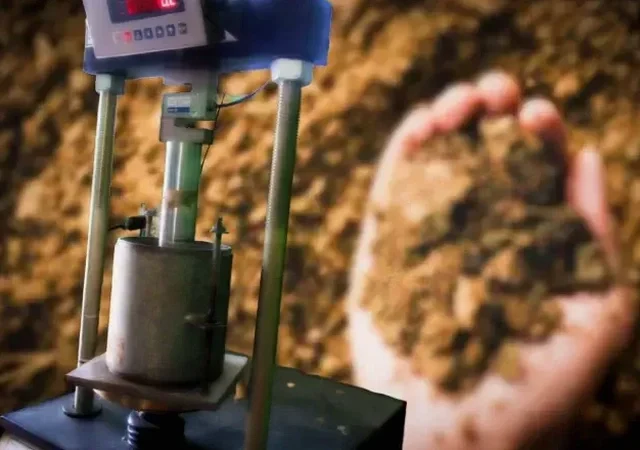
Soaked CBR values in Ballarat clays can drop 60% versus unsoaked. Design on soaked values or risk pavement failure within three years.
Technical details of the service in Ballarat
Typical technical challenges in Ballarat
A common mistake in Ballarat is designing pavements on unsoaked CBR values from nearby projects. The clays here can lose 50 to 70 percent of their strength when saturated. One local subdivision had to tear out 300 metres of road base after the first wet winter because the design CBR was taken from a dry summer test. We always run soaked laboratory CBR testing in Ballarat for any pavement that will see traffic within the first two years. The extra cost is minimal compared to a full reconstruction. Using soaked values from the lab gives you a realistic CBR that accounts for the region's rainfall pattern, which averages 693 mm per year concentrated in winter and spring.
Our services
We offer two standard configurations for the laboratory CBR test in Ballarat, depending on your project phase and material type.
Soaked CBR – Standard 4-Day Soak
Samples compacted at OMC to 95% or 100% standard Proctor, soaked for 96 hours, then penetrated. Includes swell measurement. Results reported as CBR at 2.54 mm and 5.08 mm. Recommended for all external pavements in Ballarat. Turnaround 7 business days.
Unsoaked CBR – Rapid Assessment
Same compaction and penetration procedure without the 4-day soak. Used for temporary roads, site compounds, or when material is known to be free-draining. Results available in 3 business days. Not valid for design of permanent pavements on clay subgrades.
Q&A
What is the difference between soaked and unsoaked CBR in Ballarat clays?
Soaked CBR simulates the worst-case moisture condition after wet weather. In Ballarat's basaltic clays, the soaked value can be 50 to 70 percent lower than the unsoaked value. We always recommend soaked CBR for permanent pavement design in this region. The standard soak period is 96 hours with a 4.5 kg surcharge, and we measure both swell and penetration.
How much does a laboratory CBR test in Ballarat cost?
The typical cost for a standard soaked CBR test in Ballarat ranges between AU$160 and AU$350 per sample. The price depends on whether you need unsoaked or soaked testing, the number of samples, and the compaction energy (standard vs modified Proctor). We provide a fixed quote once you specify the material type and project requirements.
What standard do you follow for the CBR test?
We follow AS 1289.6.1.1-2014, which covers the determination of the California Bearing Ratio of a soil. The test uses a 152 mm diameter mould, 4.5 kg surcharge, and a penetration rate of 1.0 mm/min. We also comply with AS 1289.5.1.1-2017 for compaction control. Our laboratory holds NATA accreditation for this method.
How many samples do I need for a pavement design in Ballarat?
For a typical subdivision or road project in Ballarat, we recommend a minimum of three CBR tests per soil type or per 500 metres of road alignment. This accounts for the natural variability in the basaltic clays and alluvial deposits. If you have multiple pavement layers (subgrade, subbase, base), each material should be tested separately. The geotechnical investigation report will specify the sampling frequency based on the project scope.